Occupation guide
Insulators and Laggers and asbestos exposure
Insulators handled raw asbestos daily and have among the highest mesothelioma rates of any trade.
- Highest risk period
- Before 1982
- Typical latency
- 20–50 years after exposure
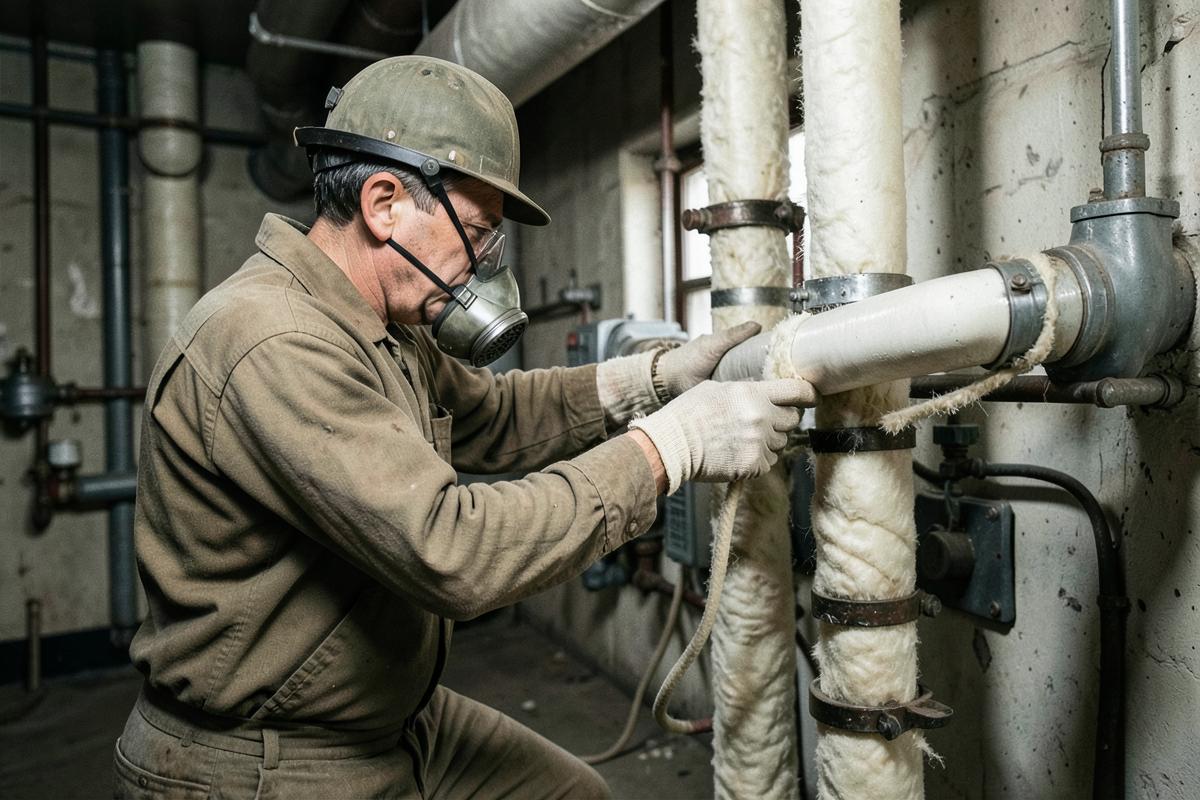
Insulators, also called laggers or heat and frost insulators, installed the covering that kept pipes, boilers, tanks and ducts at the right temperature. For decades, the material they worked with every day was asbestos. They cut it, shaped it, mixed it and tore it out, so they handled the fiber more directly than almost any other trade. Many insulators started as young apprentices and spent decades in the trade, so their exposure often began early and continued across an entire working life.
How asbestos became part of the job
Asbestos was the backbone of industrial insulation through much of the twentieth century because it resisted heat and was easy to mold. Insulators applied it as pipe covering, block, blanket and cement across power plants, refineries, ships, schools, hospitals and commercial buildings. The work was dusty by nature: sections were sawed to length, joints were packed with hand-mixed cement, and old covering was ripped out before new material went on. Insulators became one of the first groups in which the health effects of asbestos were studied closely, and their union played a large role in raising awareness. Even after substitutes arrived, insulators continued removing old asbestos during renovations, so exposure could continue into later decades. A single career might include hundreds of job sites.
Materials
Asbestos products this trade handled
The product types that come up most often when this work history is reviewed.
Molded pipe covering
Half-round sections sawed to length and wired around pipes. Kaylo is one widely documented historic brand of this type of covering.
Block and board insulation
Rigid slabs used on boilers, tanks and ducts, cut with knives and saws to fit curves and corners.
Insulating and finishing cement
Powder mixed with water in buckets and troweled over joints and fittings, one of the dustiest parts of the job.
Asbestos cloth and lagging
Fabric wrapped over insulation as a protective jacket, cut and sewn in place around elbows and valves.
Spray-applied insulation
Sprayed on structural steel and equipment in some buildings, filling the air with fibers during application.
On the job
Tasks that put fibers in the air
Exposure usually came from ordinary, repeated work rather than one event.
Sawing pipe covering to length
Hand saws and knives turned rigid insulation into fine dust that fell on clothing and hung in the air.
Mixing insulating cement
Pouring dry powder into buckets and stirring it by hand released heavy clouds of fibers at face level.
Stripping old insulation
Tearing brittle covering off pipes before re-insulating broke it into small pieces and dust across the whole work area.
Cleaning up scraps
Sweeping offcuts and dust at the end of the day stirred up fibers that had settled during the shift.
Evidence
Records that prove this kind of exposure
Decades later, these are the sources that usually rebuild the history.
| Record | Why it helps |
|---|---|
| Insulators union local records | Confirm membership, apprenticeship dates and often the contractors and jobs you were dispatched to. |
| Contractor employment records | Show which insulation contractors employed you, which helps identify the product brands they purchased. |
| Product identification testimony | Insulators often remember brand names printed on boxes, which can connect a claim to specific trusts. |
| Social Security earnings history | Fills gaps in a career that moved between many employers over decades. |
Where this work was common
Local guides for this trade
Cities whose shipyards, plants and job sites employed this trade in large numbers.
Questions
FAQs for insulators and laggers
Further reading
Explainers for this work history
Related trades
Other occupations with similar exposure
Find out in minutes whether a claim is still available
Free, confidential case review for patients and families in all 50 states.